12-09-2025 - Filmmaker Interviews
DP Amy Vincent, ASC, Crafts an Epic Musical Love Story With Sony in “Song Sung Blue”
By: Yaroslav Altunin
From comedies and horror films to modern westerns and movies steeped in music, cinematographer Amy Vincent has left an unforgettable mark on both film and television. After shooting the festival darling A Nice Indian Boy, Vincent returned to the silver screen to once again join forces with long-time collaborator director Craig Brewer.
Song Sung Blue, their fourth film together, explores the real-life story of Mike and Claire Sardina, who formed the Neil Diamond tribute band Thunder and Lightning. Filmed entirely on location, Vincent utilized the Sony VENICE 2 to craft intimate, dramatic moments and dazzling performances on stage, steeped in color.
Sony Cine sat down with Vincent to learn more about the creative evolution of Song Sung Blue, how theater lighting elevated the performances on stage, and how the VENICE 2 helped reproduce the distinct look of the 80s and 90s.
Filmmaker Interview: Vincent and Brewer Discover the Look of Song Sung Blue
Starring Hugh Jackman and Kate Hudson, Song Sung Blue takes a narrative approach to explore the life and love of Mike and Claire Sardina. Written, produced, and directed by Brewer, the film was based on a documentary of the same name by Greg Kohs, which was where Vincent and Brewer started to develop the look of the film.
"Our research really comes from Greg Kohs' documentary, which is also the root of the inspiration for Craig," Vincent said. "And we approached prep in kind of a family style. The production designer was involved in those discussions, and the set decorator and gaffer Danny McCabe.”
Yet it was the communication and working relationship that Vincent and Brewer had already developed that helped the film evolve in unique ways. As they explored new environments during location scouts, Brewer's ideas would be recorded by Vincent.
"Craig and I have an unspoken language between us," Vincent said. "A fundamental part of our collaboration is based on just really listening, and I'm accustomed to Craig's slightly unconventional way of communicating. And all that starts in the scout van, when we're on our way to start looking at locations and working with the designer."
"Driving all over New Jersey, finding locations that we could use to represent Milwaukee in the 1990s, was where the visual language began to develop."

"Craig does an extraordinary amount of thinking and talking when we're on location scouts," Vincent continued. "He often will play the music while he's walking through a location, and he'll be talking, and he'll be having ideas. And I started recording all those conversations. The amount of information that I get from Craig in those moments where he is gathering his instincts became invaluable to me."
When production started, these drives became a common occurrence as Vincent and Brewer drove to and from set. On these drives, the day ahead was fine-tuned or the day behind was debriefed.
"The way our synchronicity came together on this movie was really punctuated by the fact that — and this is a funny thing to say — we had really long commutes," Vincent shared. "We were on location deep in New Jersey, and Craig and I made the decision very early on that we were gonna ride to work together every morning at 5:30 AM. And we got so much work done during those drives."
"The other component to that drive was that we rode home together at night after a day's work, and we talked about what went well and what we're doing the next day."
"It really boils down to trust and communication in the collaborative space. Craig is like that with everyone. We become a family," Vincent added. "And with the close connection with Clay Griffith, the production designer, and Ernesto Martinez, the costume designer, we started building color palettes based on our location scouts and the realities of Greg Kohs' documentary."

Filmmaker Interview: Why Vincent Chose the VENICE 2 for Song Sung Blue
While Vincent has been shooting on the VENICE 2 for several projects, and the VENICE before that, every new film begins at square one. For Song Sung Blue, Vincent wanted not only to embody the look of the late 80s and early 90s, but also to lean on the visual style that she and Brewer loved from their earlier films.
"Craig and I, our history is very much photochemical. The other three movies [we did] were all shot on film, so I was looking for a way to present Craig with the convenience of shooting digitally, but aspiring to the photochemical look that we've come to love, and develop our own unique contrast and color," Vincent said. "I needed to assure Craig that we could achieve the photochemical look and feel, but offer him the convenience of being able to roll for 12 minutes or more consecutively through performance numbers."
Thankfully, Vincent had the opportunity to shoot extensive tests with Jackman and Hudson during pre-production, allowing the camera team to develop a single show LUT for the entire film. Crafted by Tom Poole from Company 3, the single LUT gave the entire production a clear idea of what both Vincent and Brewer saw. In the same way Vincent and Brewer communicated, the VENICE 2 enabled Vincent to share the visual language not only with Brewer but also with the entire production team.
Thankfully, Vincent had the opportunity to shoot these extensive tests with Jackman and Hudson during pre-production, allowing Tom Poole of Company 3 to develop a singular show LUT for the entire film. Via this rigorous Color Management pipeline — from the VENICE 2 sensor to the monitors on-set, through dailies, post production, and final color — the entire team was able to get a clear idea of what Vincent and Brewer had distilled into the color language of Song Sung Blue.
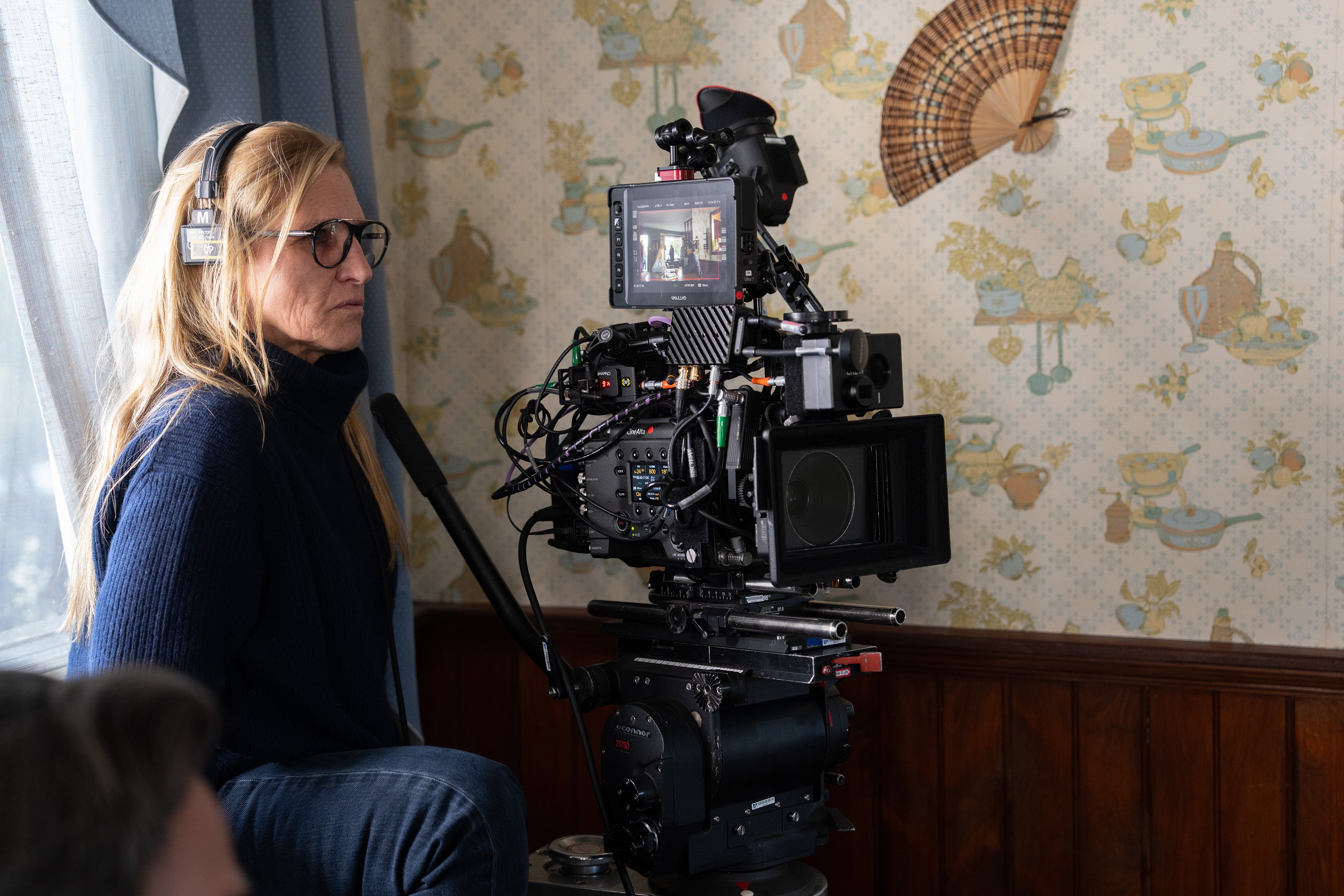
"[The] Sony VENICE had been my sensor of choice, and now it's the VENICE 2 with its smaller form factor. Everything that the VENICE 2 has to offer made it very easy for me to present that camera system and for us to sign off on it [for Song Sung Blue]," Vincent said. "[It's] the internal NDs, which have been around since the inception of VENICE, the smaller form factor of the VENICE 2, the 8.6K sensor…and also the dual ISO."
"I absolutely think that the VENICE 2 was the perfect choice for this movie. For me to be able to give Craig and the performers the freedom to go for such long takes…really gave Craig and me the ability to really roll with it."
The form factor was also a critical component for Vincent and her team. After the tests, the VENICE 2 was paired with the Leitz HUGO lenses, which gave the cinematographer and her operator complete freedom, even in tight on-location environments.
"There's an agility that you have with that camera. It's small, and it's beautiful, and you have 8.6K," Vincent said. "The entire film was shot on location, and sometimes there were space limitations in some of those places. Being able to go on to a small remote head with a Hugo Prime, and that smaller form factor, really gave my dolly grip and my camera operator the freedom to move with the music."
This was more evident with camera operator Dave Thompson, who had such a compact build of the VENICE 2 that all of the car scenes were shot handheld with Thompson sitting in the car with the talent.
Filmmaker Interview: The Colors of Song Sung Blue
With the film split into two distinct parts, one grounded and dramatic and the other vibrant and musical, Vincent created two distinct worlds that tied together with color and composition. For the cinematographer, this wasn't a musical or a biopic; it was a different kind of movie.
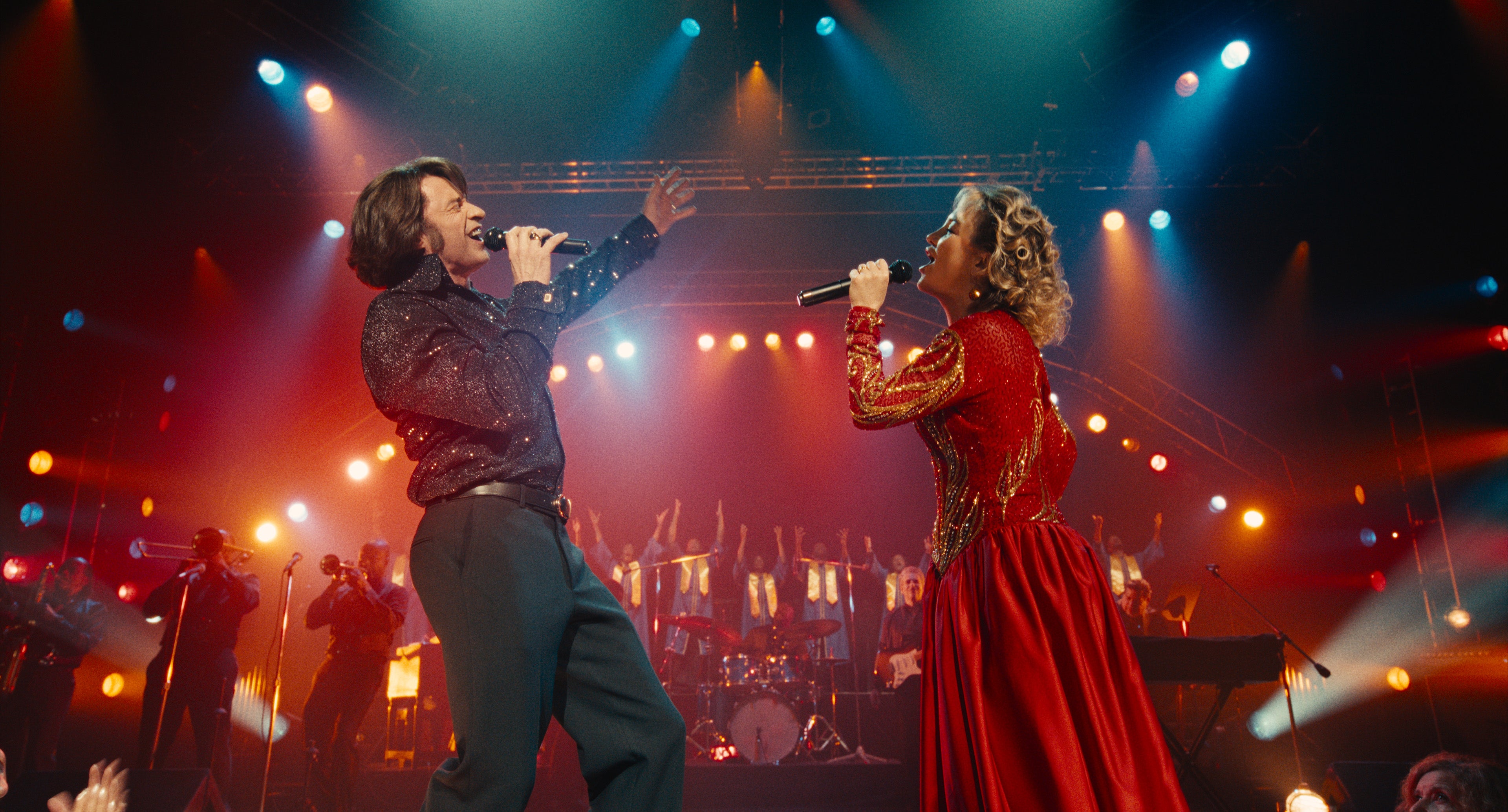
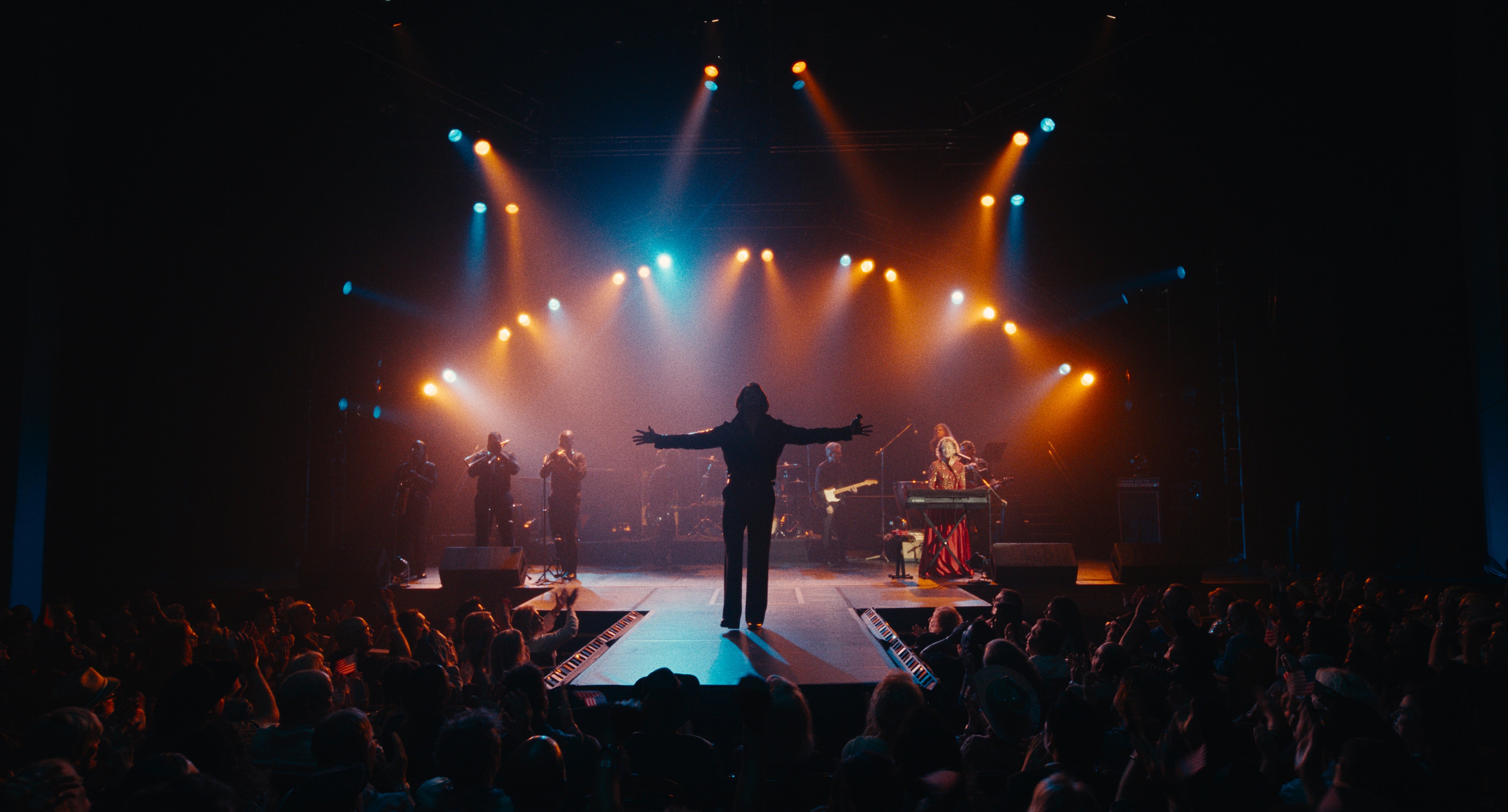
"This is not a musical. It's not a biopic. It's an epic love story with Neil Diamond's music as a support to the love story of Mike and Claire Sardina," Vincent said. "There's a building of magic and a building of the dream as Mike and Claire Sardina's performances go from being in small clubs to bigger and bigger venues until they're on the finale stage. It's very separate but integrated with the more dramatic scenes that are taking place in the family home or in Claire's first apartment."
"I used my movie star barometer in terms of saving the real movie star-style lighting and camera work to accompany the performances as they evolved. And the dramatic scenes had more of an understated tone in terms of the lighting."
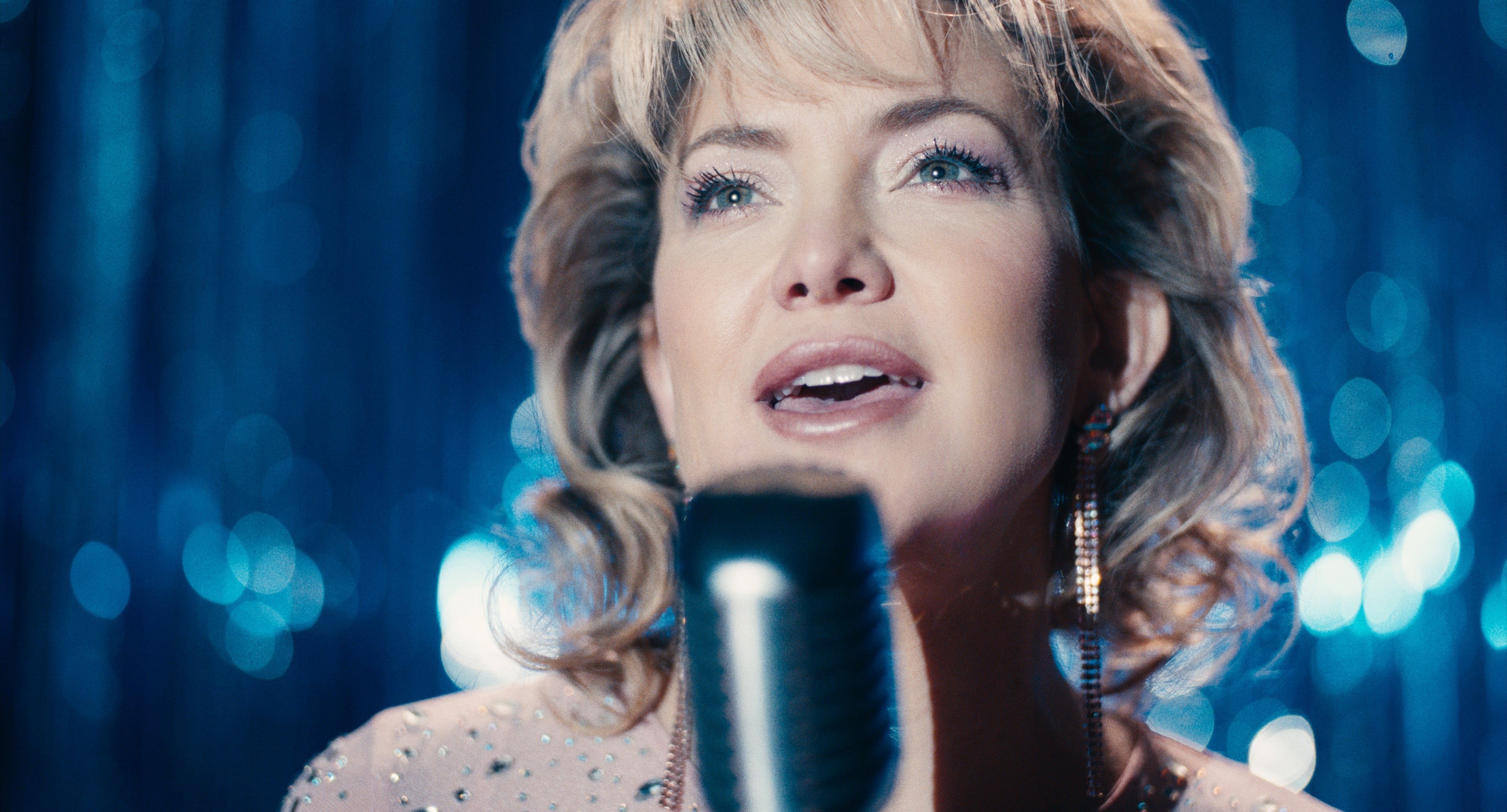
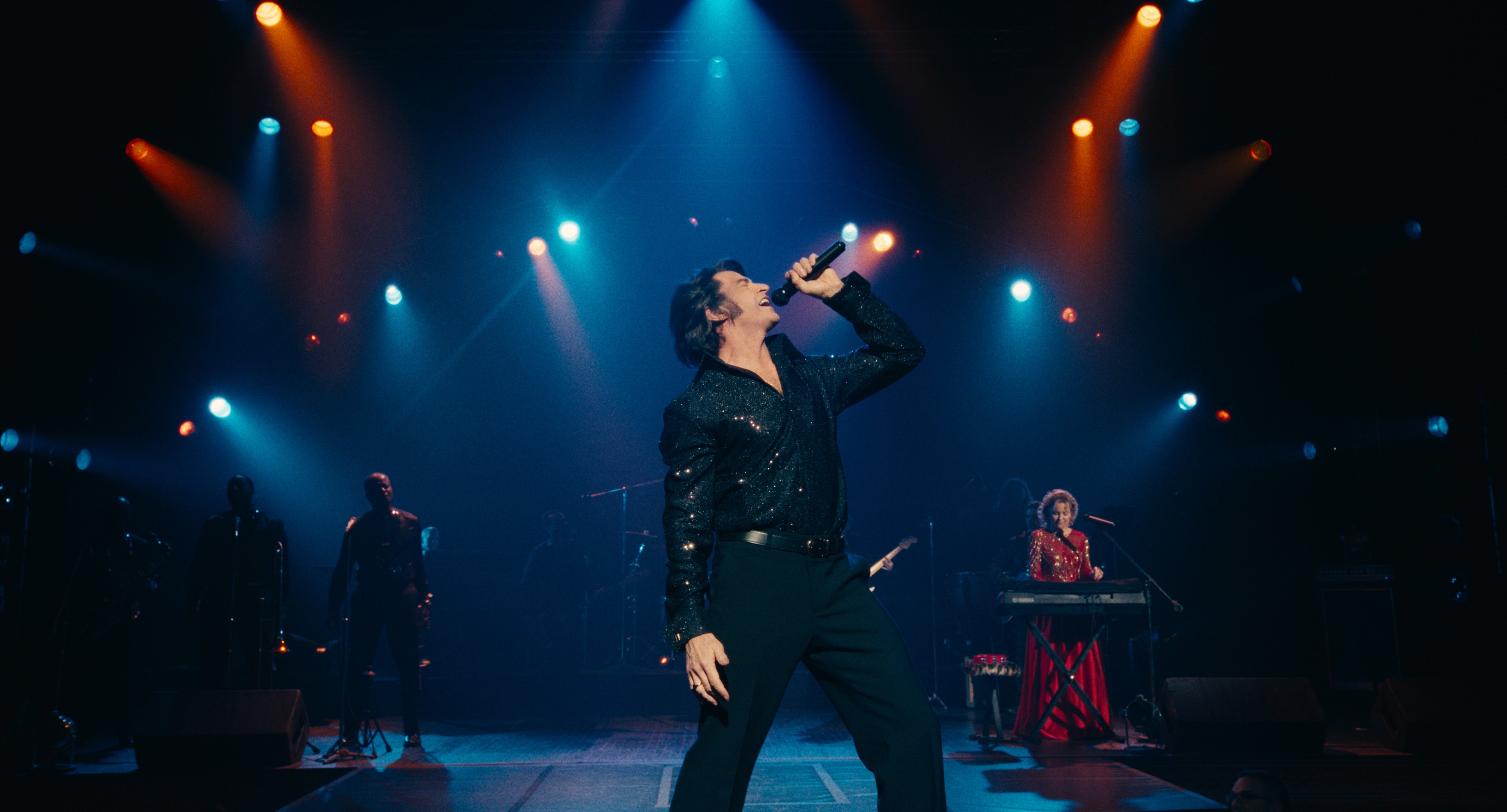
For the performances, Vincent dipped back into her roots in theatrical lighting design, bringing in lighting designer Christina See for the finale.
"There's a consistency to the color discipline across both the in-the-home and around the dramatic scenes and the performances," Vincent said. "I just love being able to photograph the lights [during the performances] that are lighting the scene, and that was what was so beautiful about installing all the period correct tungsten fixtures, the parcans, and the gels."
"It was going back to my roots, too. I come from designing lighting for theater, and I also come from the earlier days of photochemistry and using 3200K tungsten units, and there was something really great about being able to not just work with those tools, but to build my passion for those colors into the finale lighting design."
The Power of Neil Diamond’s Music
Mike and Claire Sarinda never considered themselves a tribute band. They were more of a conduit for the music of Neil Diamond. And while the film is steeped in his music, it is not a story about Neil Diamond at all, but of all the people who listen to it.
"One of the things that surprised me was — whether they're willing to admit it or not — how much people love Neil Diamond's music," Vincent said. "There was a moment towards the end of our shoot. We were out in the front yard, and there was a high school football game happening in real life in the neighborhood that we were shooting in. And the high school marching band started playing Sweet Caroline literally off in the distance."
"We had to cut, and everybody in the crew started singing along out in the front yard. It was really one of those things where you felt that Neil Diamond had really gotten into everyone's spirit and the whole crew was out singing in the cold December night."
To see Vincent's work on the big screen, see Song Sung Blue in theaters on December 25, 2025. To learn more about the Sony VENICE 2 and the other cameras in the Sony Cinema Line, visit our Camera Comparison Chart.


